J & J Collection
"The Art of Connoisseurship"
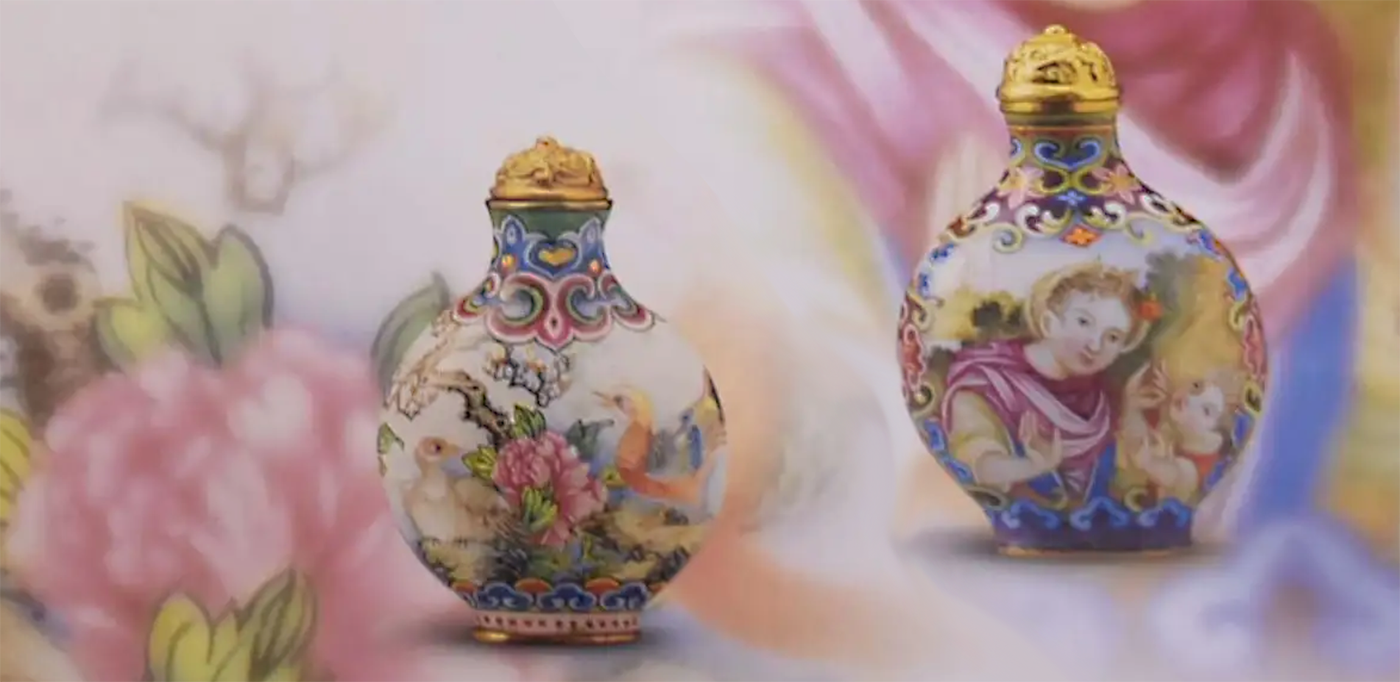
Photo: Chiriste's
The J & J Collection of James and Julie Li stands as one of the most consequential private collections in the history of the field, distinguished not only by the quality of its 451 bottles and 33 related craft items but by the philosophical shift it represented. The Lis pioneered the move away from material variety and rarity as the primary measures of a bottle's worth, championing instead a focus on esoteric artistic qualities—a shift that Hugh Moss credited with transforming the snuff bottle from an amusing material trinket into an individual work of art. The collection's nucleus was formed by Jim's father, Li Dizun (1901–1981), who served as Chinese Ambassador in a number of posts in Central and South America, with some bottles exhibited in Havana in 1945 and in Santiago in 1968. The collection toured internationally across several decades before being dispersed by Christie's in a series of sales beginning in the early 2000s.
Credited by Hugh Moss with transforming the very way collectors perceive the snuff bottle as an art form, the J&J Collection did not merely set a standard for quality — it redefined what quality meant.
Additional resources
The J&J Collection was sold in a series of auctions by Christies from 2004–2008:
Christie's Hong Kong:
Christie's New York:
- Part II (March 30, 2005)
- Part III (March 29, 2006)
- Part IV (March 22, 2007)
- Part V (September 17, 2008)
From the collection

Imperial famille-rose enamelled glass in double gourd form
China (Beijing, Palace Workshops), 1736–1780, Qing dynasty, Qianlong period. Snuff bottle. Translucent white glass of double gourd form, enamelled in famille-rose with blossoming lilies and roses on a yellow ground, with a border of blue dots at the foot and a formalized floral border at the neck; Qianlong nianzhi mark in blue enamel regular script on base; gilt porcelain stopper. Photo: Christie's.
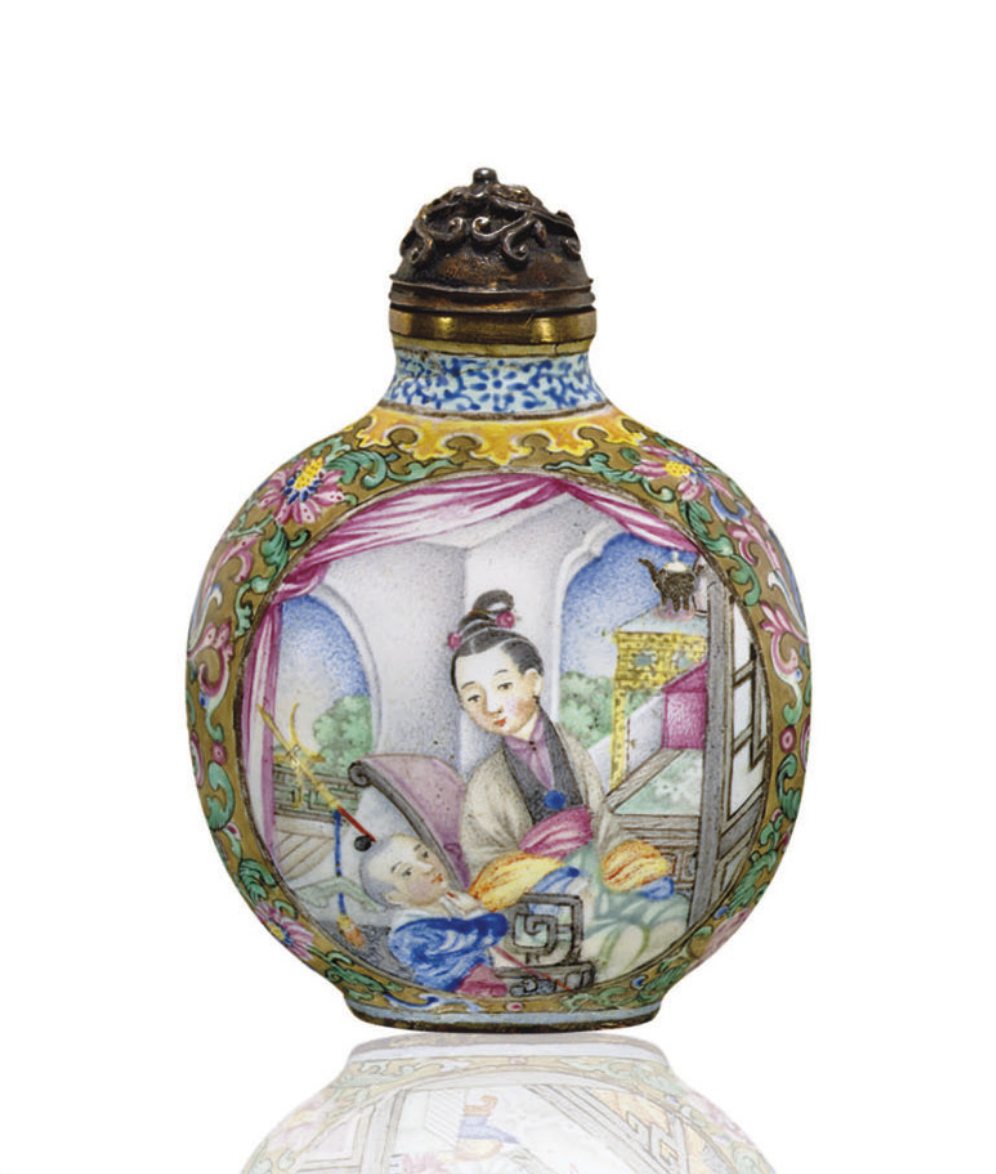
Imperial enamel on copper with ladies and children
China (Beijing, Palace Workshops), 1736–1750, Qing dynasty, Qianlong period. Snuff bottle. Famille-rose enamels on copper, painted with a lady reclining in an armchair with a boy looking up at her on one side, and a young woman arranging her coiffure with a boy in attendance on the other, within elaborate formalized floral borders; lingzhi band at shoulders; Qianlong nianzhi mark in blue enamel regular script on base; gilt bronze stopper with pierced floral design, possibly original. Photo: Christie's.

Turquoise with inscription and Tian family seal
China, 1700–1850, Qing dynasty. Snuff bottle. Bluish-green turquoise with jagged black matrix, inscribed in seal script Quexi Zhai zhenwan ("For precious enjoyment at the Happy Magpie Studio") with Tian shi seal; coral stopper carved with a chi dragon; turquoise collar. Photo: Christie's.

Jade pebble with scholar playing qin in a landscape
China (Suzhou), 1680–1780, Qing dynasty. Snuff bottle. Jade pebble of compressed form, carved with a continuous rocky landscape with plantains and a wutong tree on one side, and a seated scholar holding a qin before a rocky outcrop with a brazier, tea-kettle, and censer on the other; amber stopper with jadeite finial. Photo: Christie's.

Imperial russet and yellowish-green jade with archaistic scrolls and double gourd
China (Beijing, Palace Workshops), 1736–1795, Qing dynasty, Qianlong period. Snuff bottle. Russet and yellowish-green jade of compressed form, carved with continuous archaistic scrolls framing a beribboned double gourd; Qianlong yuzhi mark incised in seal script on base; glass stopper with silver collar. Photo: Christie's.
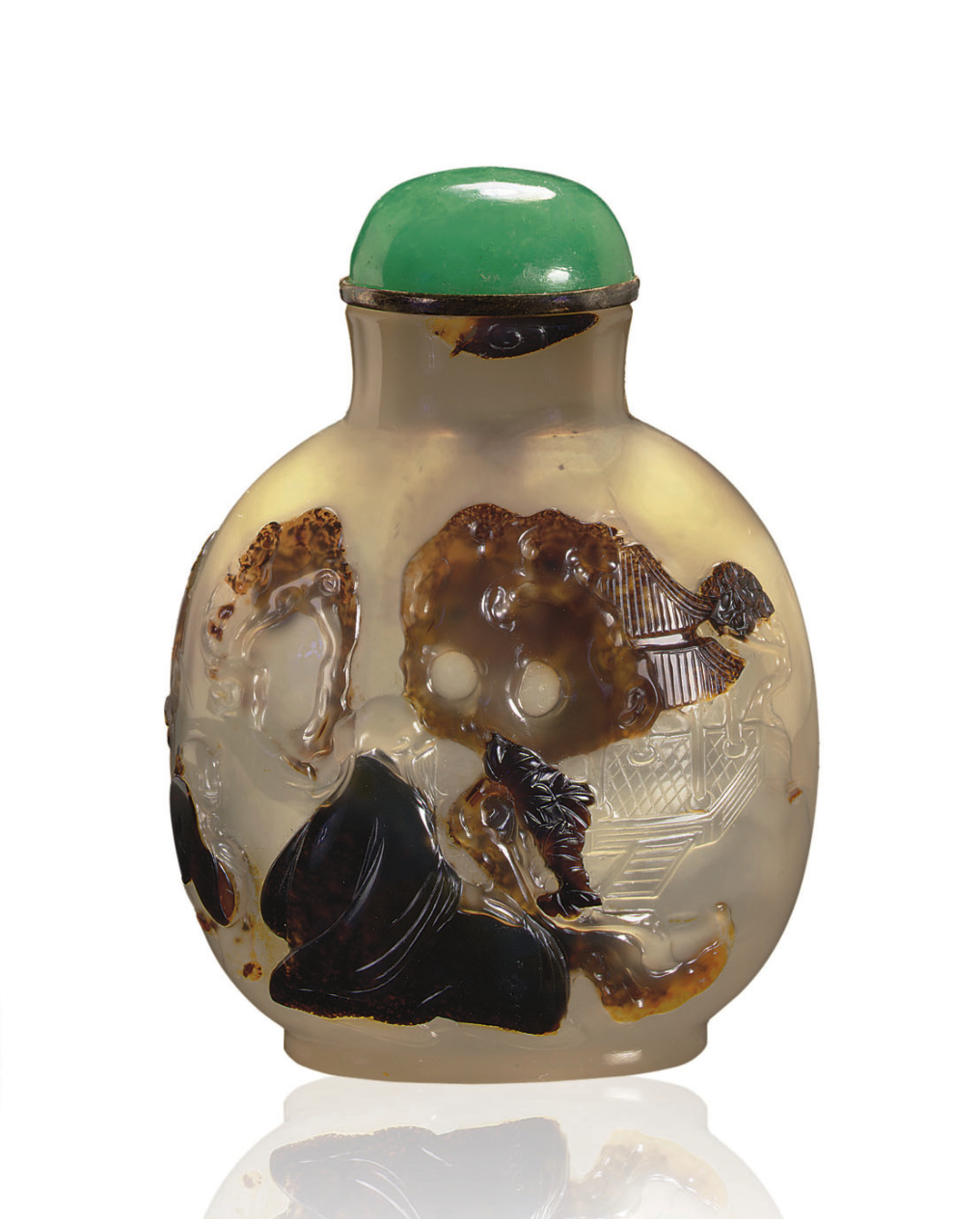
Agate carved with scholar and attendant in a landscape
China (Suzhou), 1740–1860, Qing dynasty. Snuff bottle. Agate of compressed form, carved with a continuous landscape depicting a scholar and attendant near a pavilion with pierced rockwork, a deer, a mythical beast, and a bird on a branch; inscribed in clerical and draft scripts with a nian seal; glass stopper with gilt-metal collar. Photo: Christie's.
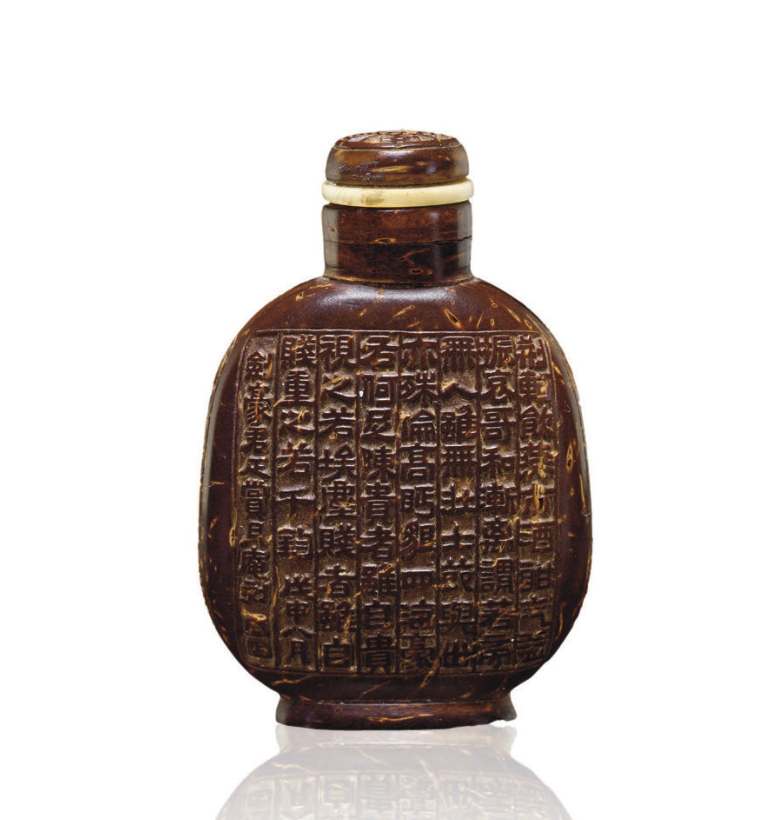
Coconut shell with relief inscriptions by Yue'an
China, bottle probably 1820–1848, decoration probably 1848, Qing dynasty. Snuff bottle. Coconut shell of flattened form, carved on each main side with lengthy relief inscriptions in seal and clerical script, with further inscriptions on the narrow sides and footrim; inscribed "Carved by Yue'an" and dated to the eighth month of the wushen year; original coconut-shell stopper carved with a cash design and four-character inscription, with ivory collar. Photo: Christie's.

Agate cameo with two horses in a landscape
China, 1740–1820, Qing dynasty, Official School. Snuff bottle. Agate of compressed form, carved using natural coloring as a cameo with a continuous scene of two horses in a rocky landscape with a pine tree and lingzhi; quartz stopper with gilt-metal collar. Photo: Christie's.

Enamelled glass with lotus and dragonfly, signed Wu Yuchuan
China (Beijing, Palace Workshops), 1770–1799, Qing dynasty, Qianlong period. Snuff bottle. Glass painted with a continuous design of flowering lotus, grass, and a hovering dragonfly, inscribed with a couplet in draft script signed Yuchuan with three seals; leiwen border at neck and lingzhi band at shoulder; attributed to Wu Yuchuan; tourmaline stopper. Photo: Christie's.

Amber in the form of a seated bear
China, 1730–1850, Qing dynasty. Snuff bottle. Amber carved in the form of a seated bear with its chin resting on its torso; pearl stopper with turquoise finial. Photo: Christie's.

Honey agate with horses, monkey, and lingzhi
China, 1760–1840, Qing dynasty, Official School. Snuff bottle. Honey-beige agate with mottled tortoiseshell areas, carved using natural dark inclusions with two horses, one recumbent and one grazing, a monkey holding a stick, and two sprigs of lingzhi on rockwork; amber glass stopper with silver collar. Photo: Christie's.
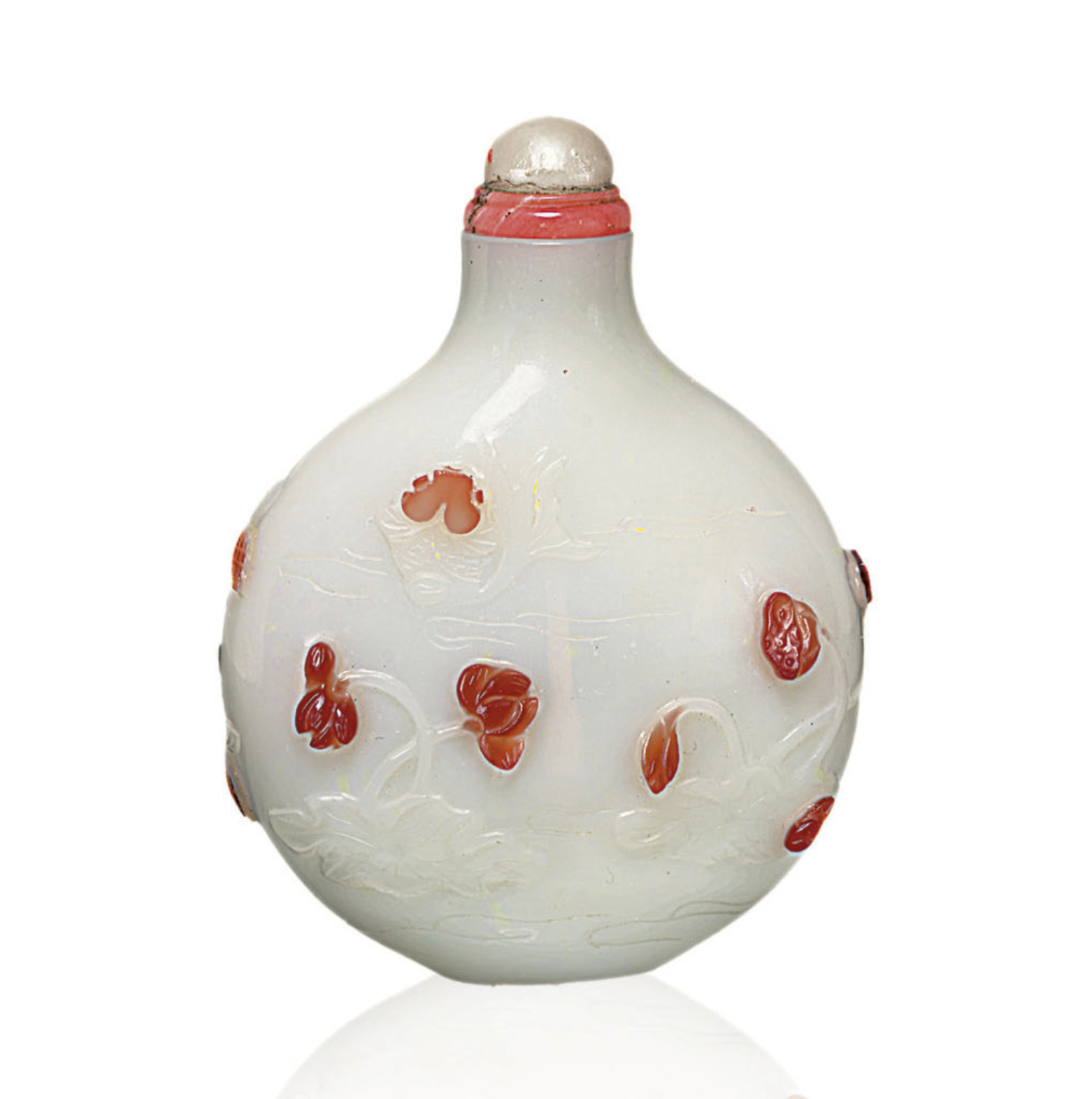
Red overlay on white glass with goldfish in a lotus pond
China (Yangzhou), 1790–1830, Qing dynasty, attributed to Li Junting. Snuff bottle. White glass with transparent red overlay carved with a continuous scene of two fan-tailed goldfish in a lotus pond with a leafy shrub on ornamental rockwork; pearl stopper with coral collar. Photo: Christie's.

Streaky emerald-green jadeite
China, 1780–1880, Qing dynasty. Snuff bottle. Jadeite of compressed form with streaky emerald-green tone; coral stopper with pearl finial. Photo: Christie's.
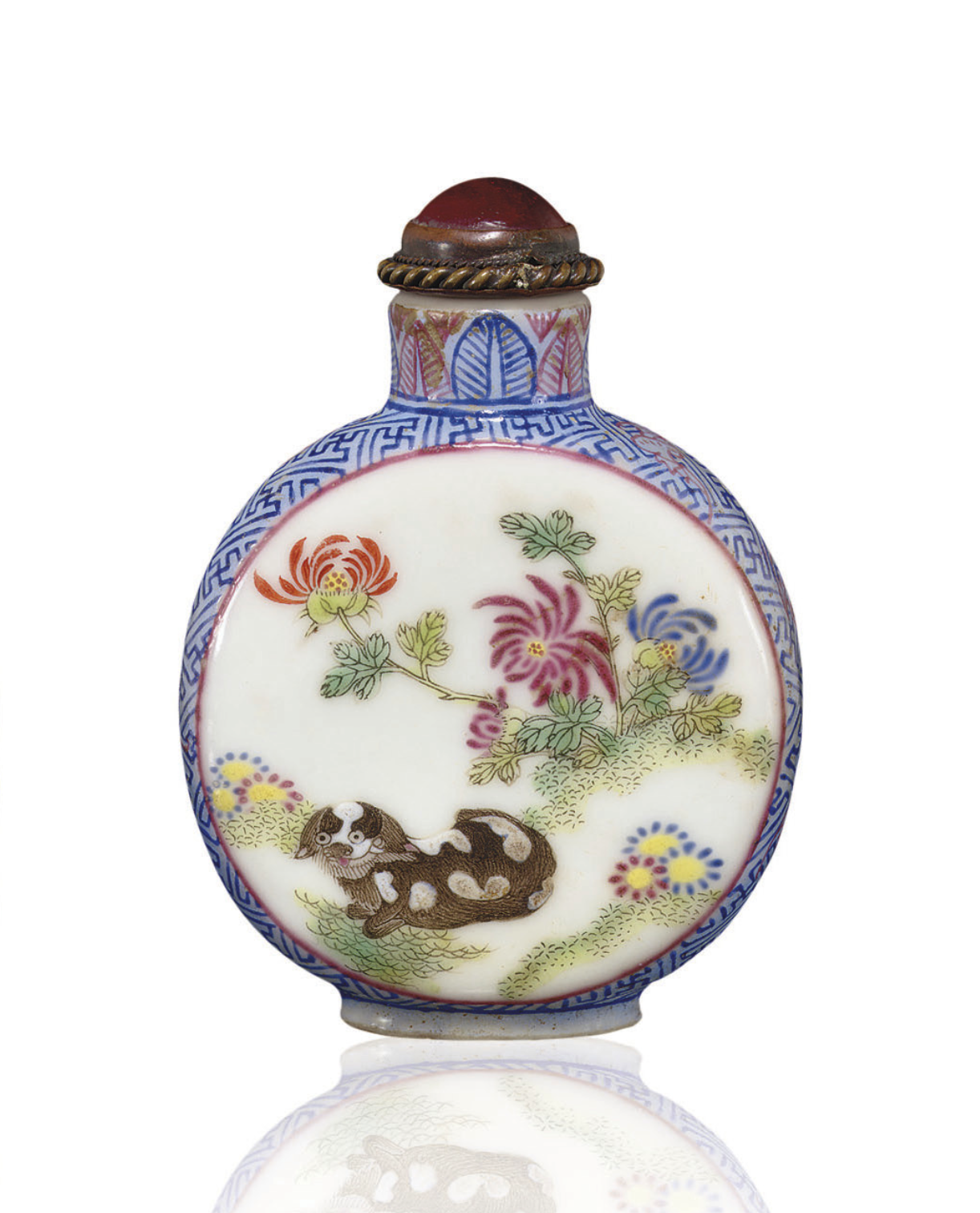
Famille-rose porcelain with Pekinese dogs in a garden
China (Jingdezhen, Imperial Kilns), 1821–1850, Qing dynasty, Daoguang period. Snuff bottle. Porcelain painted in famille-rose enamels with a Pekinese dog in a garden setting on each side, swastika-diaper ground with ruby bats on the narrow sides, and upright lappets at the neck; Daoguang nianzhi seal mark in iron red on base; glass stopper with copper collar. Photo: Christie's.

Cinnabar lacquer with scholar arriving by lake
Japan, 1860–1920. Snuff bottle. Cinnabar lacquer carved in deep relief through red and green layers to an orange ground, with a continuous scene of a scholar arriving on horseback at a lakeside, greeted by a woman while attendants and boatmen with a pleasure boat look on, in a landscape of rocks, pine, willow, and plantain; lappet band at shoulder and leiwen border at neck; Qianlong nianzhi mark in regular script on base; cinnabar-red and green lacquer on bronze stopper. Photo: Christie's.
The International Chinese Snuff Bottle Society
2 Hamill Road, Suite 353
Baltimore, MD 21210 USA
410-467-9400