Hildegard Schonfeld Collection
"A Life's Journey in Miniature"
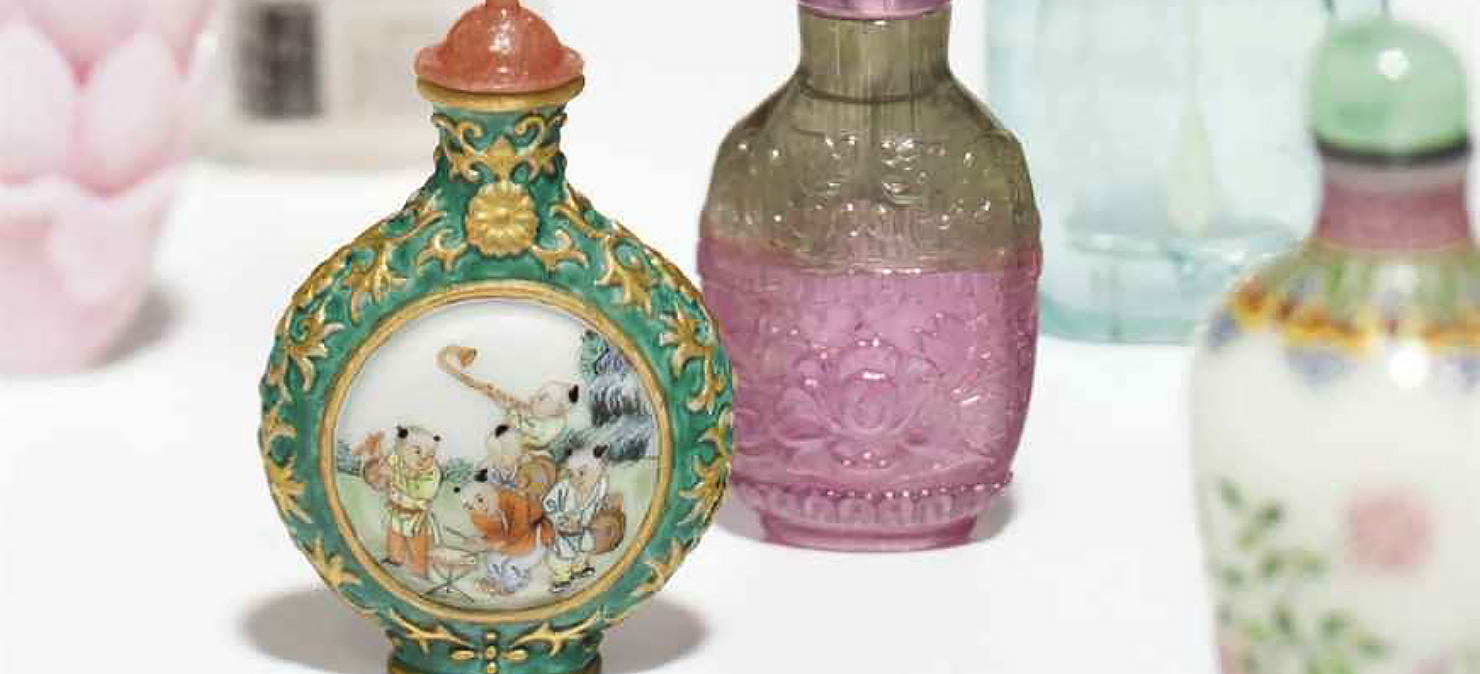
Photo: Christie's
Hildegard Schonfeld (1923–2010) began her collecting life in 1973, when a chance encounter in a San Francisco antique shop stopped her in her tracks. Two small bottles caught her eye, and what followed was nearly three decades of dedicated pursuit, befriending dealers and scholars, keeping meticulous records on every purchase, and traveling the world with her husband Sidney to attend conventions, auctions, and exhibitions. The collection's range was exceptional, from an imperial tourmaline bottle of the Palace Workshops ingeniously carved to exploit the material's contrasting pink and green zones, to a rare aquamarine of even icy pale blue tone. Among Hilde's personal favorites were a sandwiched pink glass lotus bottle from the Imperial Glassworks and a rare hexagonal Yixing stoneware bottle painted in slip with a landscape scene.
Built from a single chance encounter in 1973 and pursued with scholarship and devotion for nearly three decades, the Schonfeld Collection ranged from imperial Palace Workshop tourmaline to rare Yixing stoneware, assembled by one of the field's most meticulous and devoted collectors.
Additional resources
From the collection
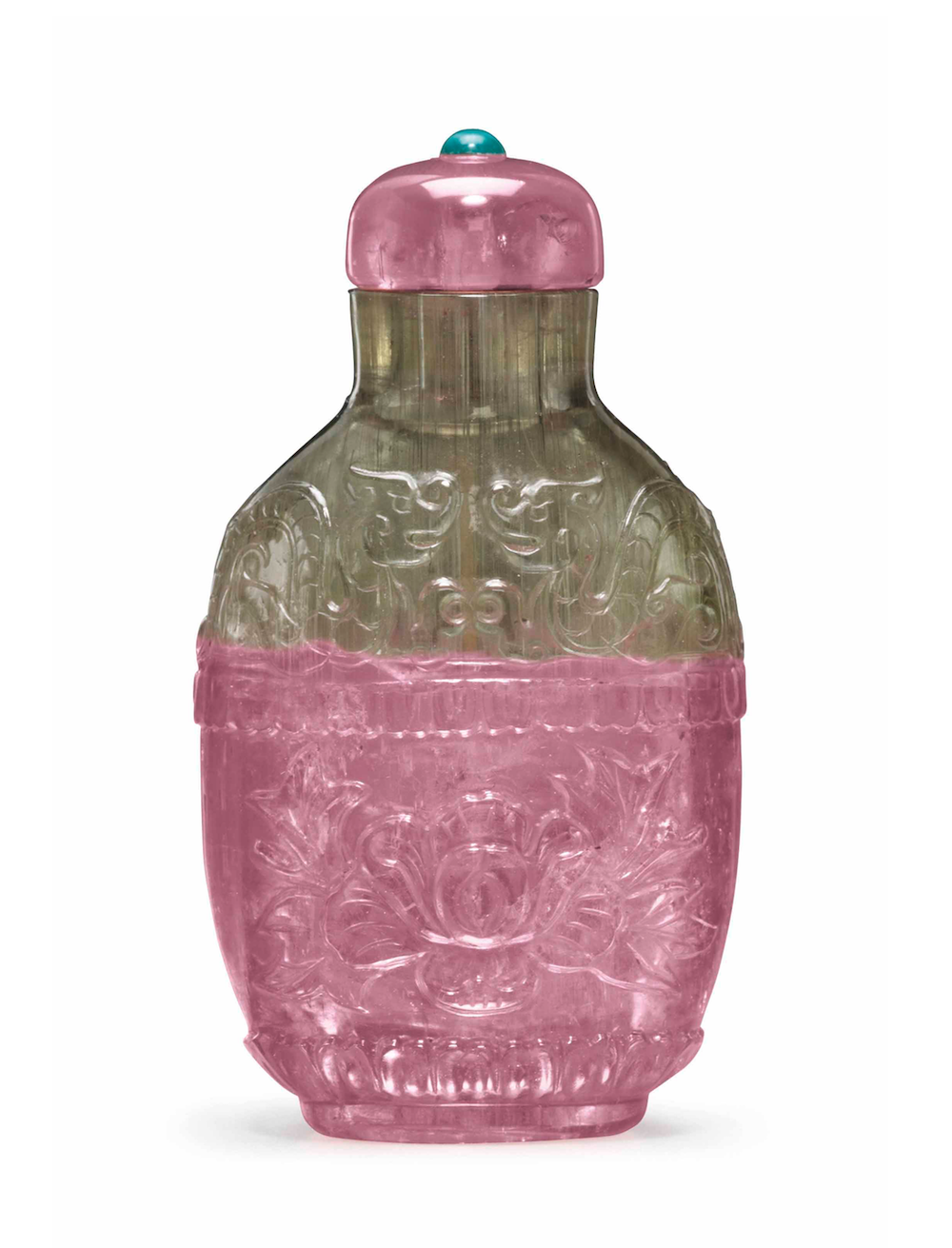
Tourmaline carved with peony, lotus, and chi dragons
China (Palace Workshops), 1760–1799, Qing dynasty, Qianlong period. Snuff bottle. Green and pink tourmaline ingeniously carved to exploit the natural color contrast, with a peony blossom and lotus bouquet on the rose-pink lower section and confronted chi dragons on the pale sea-green upper section; glass stopper. Photo: Christie's.
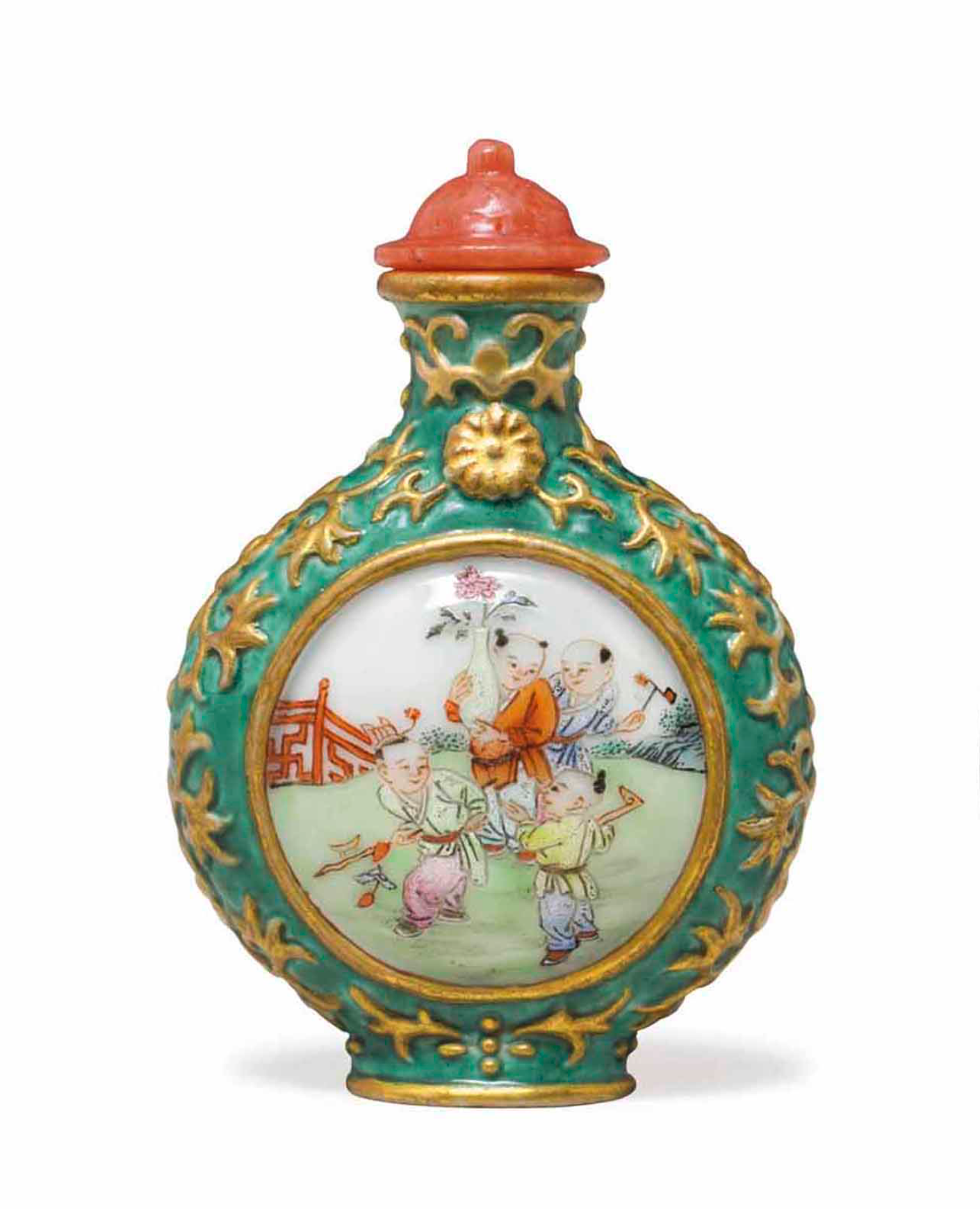
Famille-rose porcelain with boys in garden panels
China (Jingdezhen, Imperial Kilns), 1740–1756, Qing dynasty, Qianlong period. Snuff bottle. Porcelain of flattened rounded form with tall cylindrical neck, moulded with chrysanthemum scroll in gilt on a greenish-turquoise ground, with raised circular panels painted in famille-rose enamels depicting boys playing musical instruments on one side and boys carrying auspicious objects including a ruyi scepter, chime, and flower vase on the other; Qianlong nianzhi seal mark in iron red on base; coral stopper. Photo: Christie's.

Aquamarine of even icy pale blue tone
China, 1760–1800, Qing dynasty. Snuff bottle. Aquamarine of flattened rounded rectangular form with even icy pale blue tone; tourmaline stopper. Photo: Christie's.
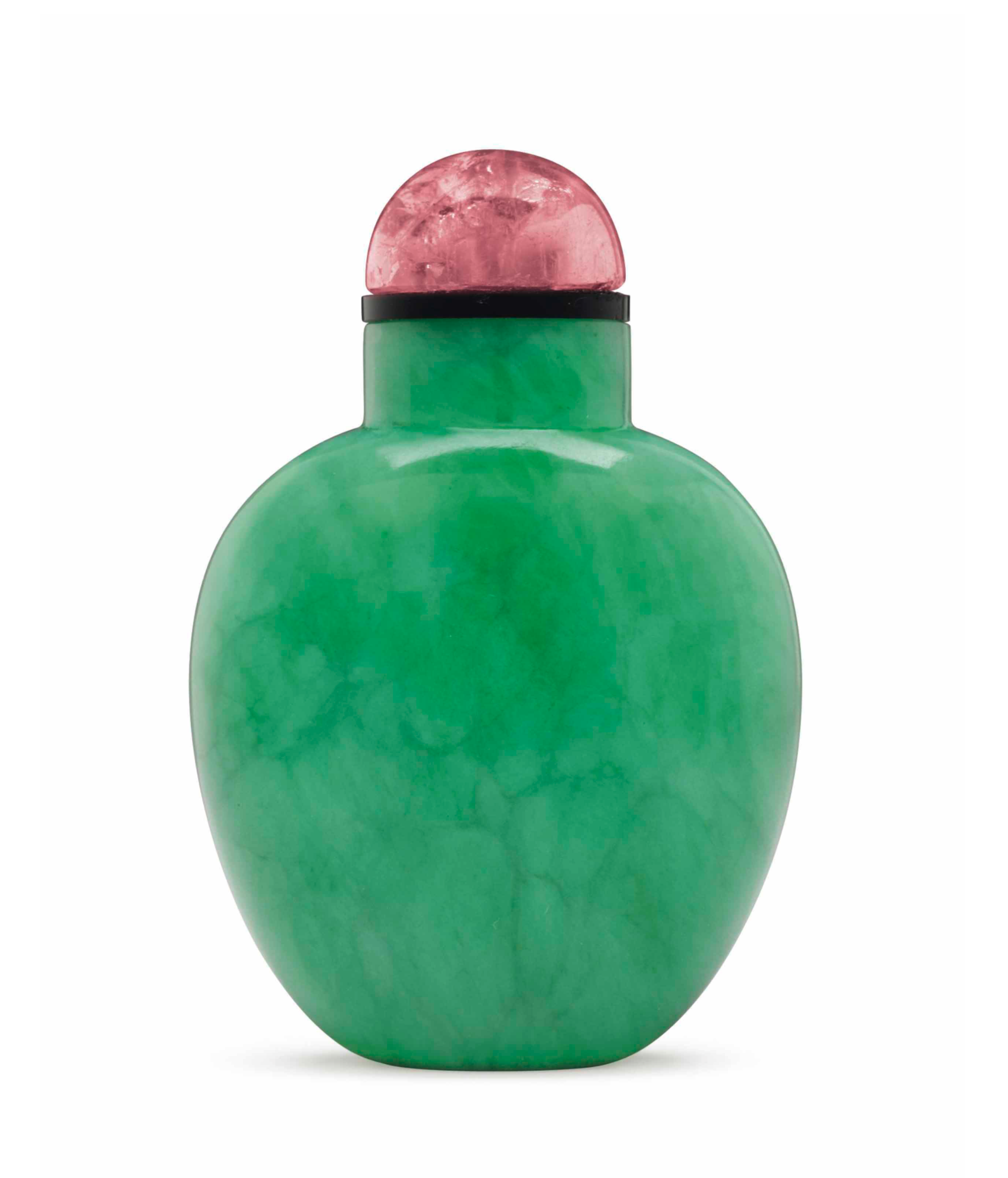
Milky emerald-green jadeite
China, probably Imperial, 1770–1830, Qing dynasty. Snuff bottle. Jadeite of flattened ovoid form, suffused with pale milky emerald-green cloud-like mottling; rose quartz stopper. Photo: Christie's.

Black-enamelled blue and white porcelain with scholar in landscape
China (Jingdezhen, Imperial Kilns), 1795–1799, Qing dynasty, Qianlong period. Snuff bottle. Porcelain of flattened high-shouldered form, painted in black enamel on each side with a scholar and attendant strolling in a rocky landscape with pine trees; stylized floral bands in underglaze blue on the narrow sides and neck; Qianlong four-character mark in underglaze blue on base; coral stopper with faux-pearl finial. Photo: Christie's.

Cameo agate with the Four Noble Professions
China (Suzhou, Zhiting School), 1760–1850, Qing dynasty. Snuff bottle. Agate of ovoid form, carved using natural brown markings as a cameo with a continuous mountainous landscape depicting a scholar, woodcutter, fisherman, and farmer; jadeite stopper. Photo: Christie's.

Yellowish-green and russet jade with chi dragons and rising sun
China, 1740–1840, Qing dynasty, Master of the Rocks School. Snuff bottle. Yellowish-green jade with russet-brown skin, carved with confronted chi dragons on one side, the rising sun amid wispy clouds on the other, and chi dragons grasping lingzhi branches on the narrow sides; coral stopper. Photo: Christie's.

Sandwiched pink glass in the form of a lotus
China (Beijing, probably Imperial Glassworks), 1740–1800, Qing dynasty. Snuff bottle. Semi-opaque white glass over pale pink ground, of tapering ovoid form carved with overlapping lotus petals issuing from a curled lotus leaf, with finely incised veining throughout; rose quartz stopper. Photo: Christie's.

Yixing stoneware with slip-painted landscape and berries
China (Yixing), 1770–1820, Qing dynasty, the Slip Master. Snuff bottle. Brown stoneware of tapering hexagonal form, painted in beige slip with a riverside pavilion landscape on one side and leaves and berries on the other; foliate scroll at shoulder; hardstone stopper with bone spoon. Photo: Christie's.

Imperial carved red lacquer with boys at play
China, 1700–1800, Qing dynasty. Snuff bottle. Carved red lacquer of high-shouldered flattened ovoid form, depicting four boys watching a fifth on a swing on one side, and five boys with a chime, brush, and halberd on the other, with pine and ornamental rocks on the narrow sides; red lacquer stopper. Photo: Christie's.
The International Chinese Snuff Bottle Society
2 Hamill Road, Suite 353
Baltimore, MD 21210 USA
410-467-9400