Mary & George Bloch Collection
"The Highest Standard"

George Bloch (1920–2009) and Mary Bloch began collecting snuff bottles in 1983, acquiring at auction and from leading international dealers to build a collection of 1,720 bottles widely regarded as the highest quality collection of snuff bottles ever assembled in private hands. The breadth of the collection was matched by the depth of its documentation: Hugh Moss, Victor Graham, and Ka Bo Tsang catalogued the holdings across seven volumes published between 1996 and 2009, covering jade, quartz, stone, inside-painted, glass, arts of the fire, and organic and mixed media bottles. Following George Bloch's death in 2009, the collection was dispersed in ten parts, beginning at Bonhams Hong Kong in 2010 and continuing at Sotheby's Hong Kong from Part VI onward.
Assembled from 1983 onward with an unwavering commitment to quality and documented across seven landmark volumes, the Bloch Collection set the standard by which all modern private collections are measured.
Additional resources
The Bloch Collection was sold through a series of auctiossn by Bonhams and Sotheby's in 2010–2015.
Bonhams Hong Kong:
- Part I (May 28, 2010)
- Part II (November 23, 2010)
- Part III (May 2011)
- Part IV (November 28, 2011)
- Part V (May 27, 2012)
Sotheby's Hong Kong:
- Part VI (May 2013)
- Part VII (November 2013)
- Part VIII (May 2014)
- Part IX (November 2014)
- Part X (May 2015)
From the collection
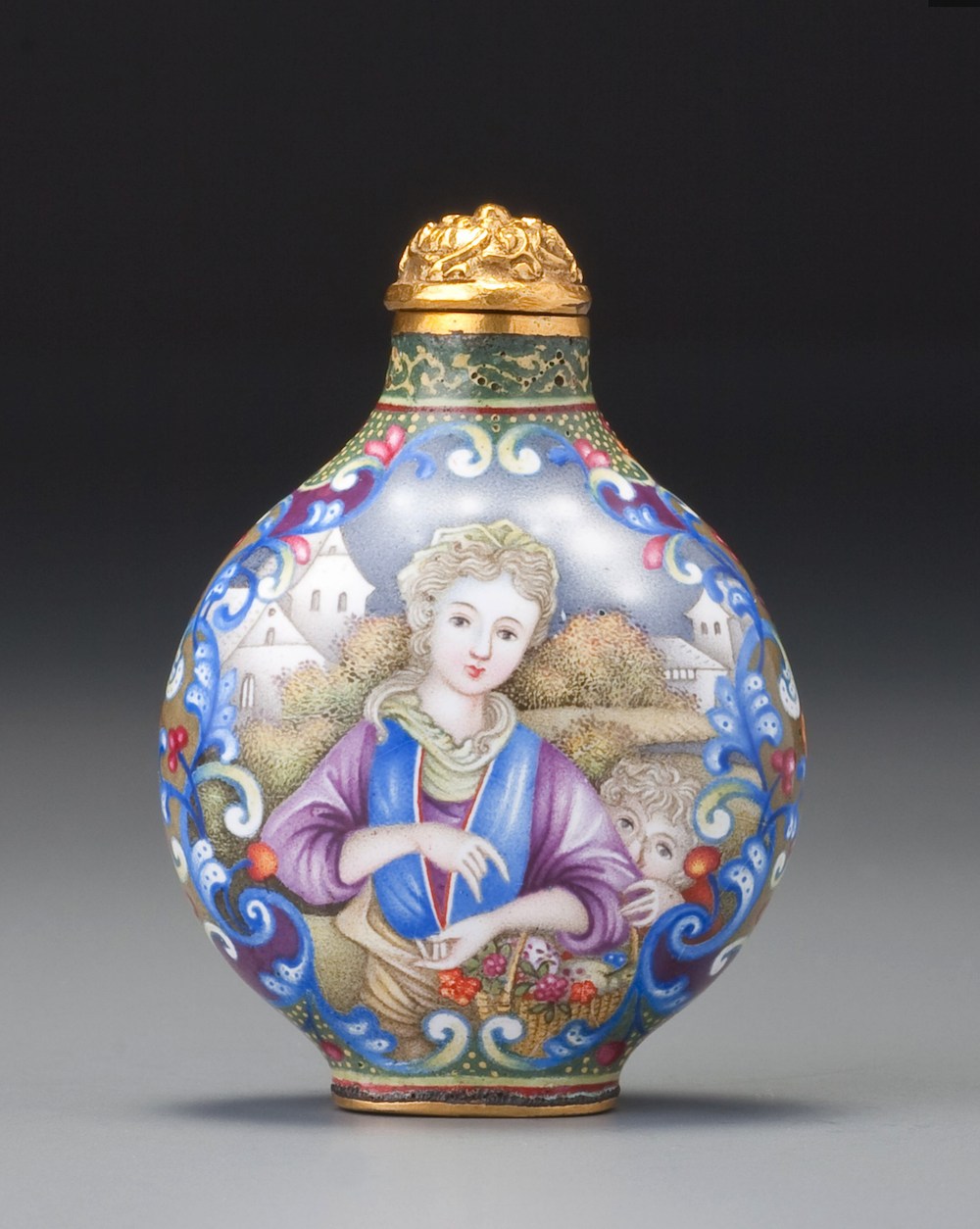
Enamel on copper with European mother and child
China (Beijing, Palace Workshops), 1736–1760, Qing dynasty, Qianlong period. Snuff bottle. Famille-rose enamels on copper with gilt, painted on each side with a foliate panel depicting a European woman and child against an architectural landscape with gathering clouds; formalized floral borders; Qianlong nianzhi mark in blue regular script on base; gilt bronze stopper. Photo: Bonhams

Nephrite pebble carved with scholars in a rocky landscape
China (Suzhou, Zhiting School), 1740–1840, Qing dynasty. Snuff bottle. Nephrite of pebble material with russet-brown skin, carved with a continuous rocky landscape depicting a scholar inscribing the characters shi ru jin ("stone prized like gold") on a cliff face with an attendant at his side, and an elderly scholar walking beside a lotus pond on the other; jadeite twig stopper. Photo: Bonhams.

Famille-rose enamelled glass with bird on branch
China (Beijing, Palace Workshops), 1736–1760, Qing dynasty, Qianlong period. Snuff bottle. Famille-rose enamels on semi-transparent milky glass, painted with a continuous scene of a white-headed bulbul perched on a leafy branch with asters, a butterfly settling on a tree peony, and budding branches; formalized lingzhi bands at neck, shoulders, and foot; Qianlong nianzhi mark in blue regular script on base; gilt bronze stopper. Photo: Bonhams.

Enamel on copper with millefleurs design
China (Beijing, Palace Workshops), 1736–1770, Qing dynasty, Qianlong period. Snuff bottle. Famille-rose enamels on copper with gilt, painted with a continuous millefleurs design of peonies, camellias, pear blossom, convolvulus, chrysanthemums, orchids, hydrangeas, irises, hibiscus, asters, and lilies; formalized floral bands at neck and foot; Qianlong nianzhi mark in blue regular script on base; gilt bronze stopper. Photo: Bonhams.
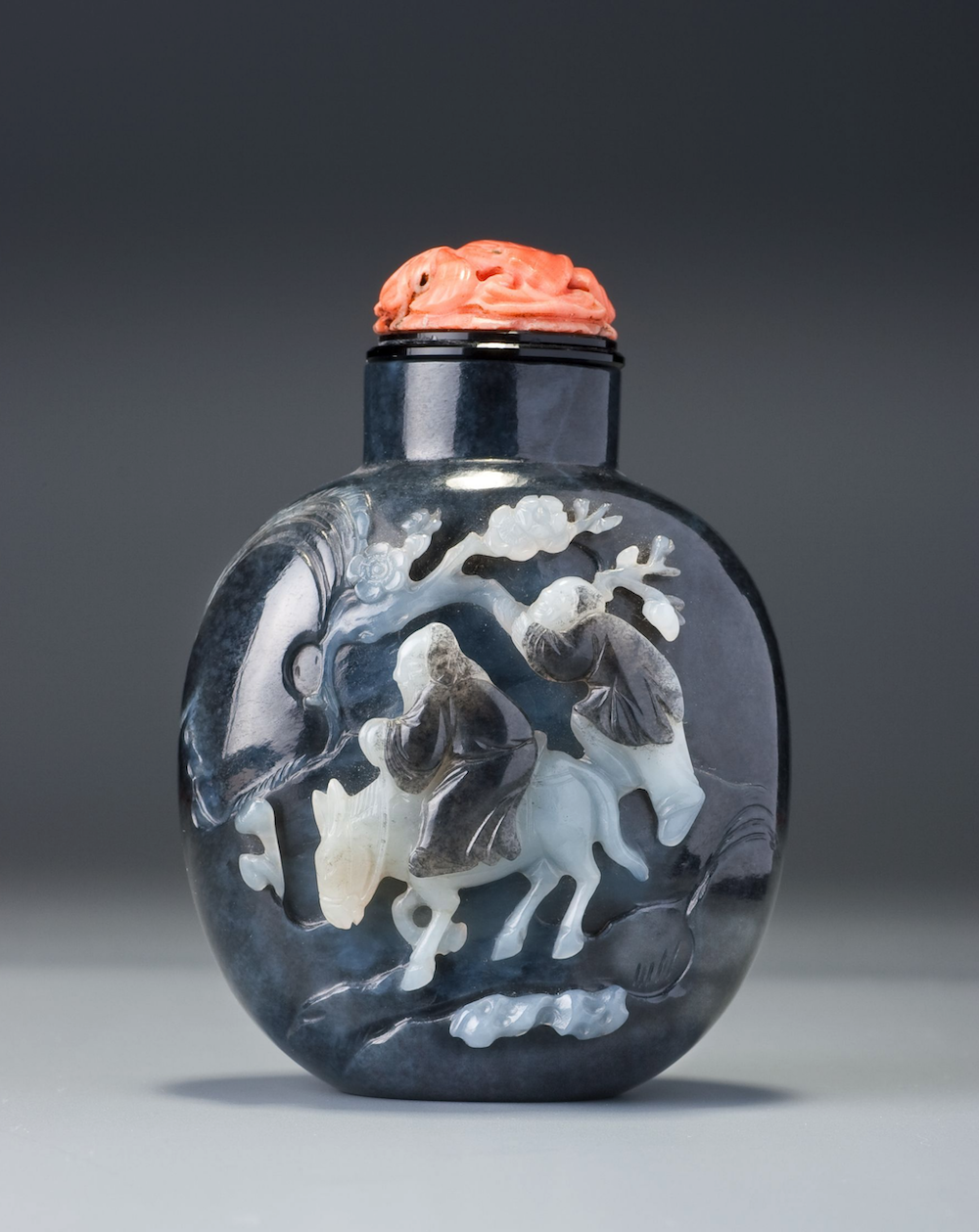
Black and white nephrite with Meng Haoran seeking prunus blossoms
China (Suzhou, Zhiting School), 1740–1850, Qing dynasty. Snuff bottle. Nephrite in contrasting black and white layers, carved with Meng Haoran on a donkey beneath a blossoming prunus tree, an attendant reaching to pick a branch, and lingzhi among the rocks on one side, and a walled compound nestled against a cliff face on the other; coral stopper carved as a fan-tailed goldfish. Photo: Bonhams.

Sapphire
China, possibly Imperial, 1770–1850, Qing dynasty. Snuff bottle. Sapphire of compressed spherical form; tourmaline stopper with jadeite collar. Photo: Bonhams.

Blue jadeite
China, 1770–1860, Qing dynasty. Snuff bottle. Blue-grey jadeite of compressed oval form with crystalline markings; tourmaline stopper. Photo: Bonhams.

Double overlay glass with dragons among clouds and waves
China (Beijing, Imperial Glassworks), 1760–1790, Qing dynasty, Qianlong period. Snuff bottle. Milky white glass with double overlay of sapphire-blue and white, carved with a continuous design of two four-clawed dragons, one among formalized clouds and the other rising from waves; ivory stopper with gilt-bronze collar. Photo: Bonhams.

Walnut shell inscribed with Tao Qian's "Home Again"
China (Beijing, Palace Workshops), 1736–1799, Qing dynasty, Qianlong period. Snuff bottle. Walnut shell carved on one side with an illustration of Tao Qian returning home to his family, and on the other with the full text of his poetic composition "Home Again" in regular script; Qianlong nianzhi seal mark incised on a narrow-side rib; jadeite stopper carved as a hand holding a peach. Photo: Bonhams.
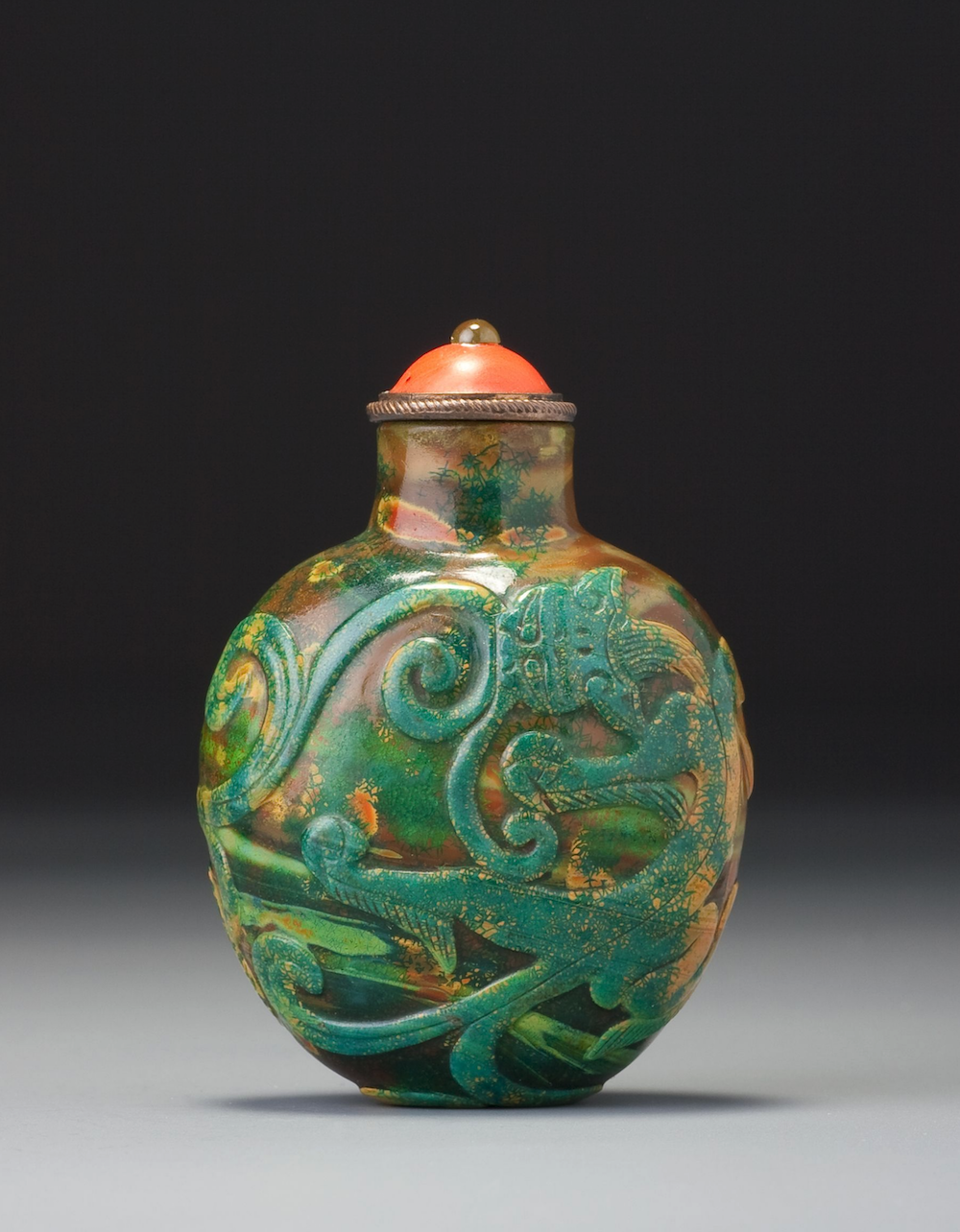
Realgar glass carved with two chi dragons
China (Beijing, Imperial Glassworks), 1700–1740, Qing dynasty. Snuff bottle. Opaque variegated orange, brown, green, and yellow glass imitating realgar, carved with a continuous design of two chi dragons, one holding the tail of the other in its mouth; coral stopper with glass finial and gilt-silver collar. Photo: Bonhams.

Dendritic chalcedony with scholar in a garden
China (Suzhou, Zhiting School), 1730–1850, Qing dynasty. Snuff bottle. Dendritic chalcedony carved with a continuous scene of a scholar in full robes holding a brush above a painting table in a rocky garden with pine and maple trees and lingzhi, his attendant walking away carrying a book; turquoise stopper with silver collar. Photo: Bonhams.
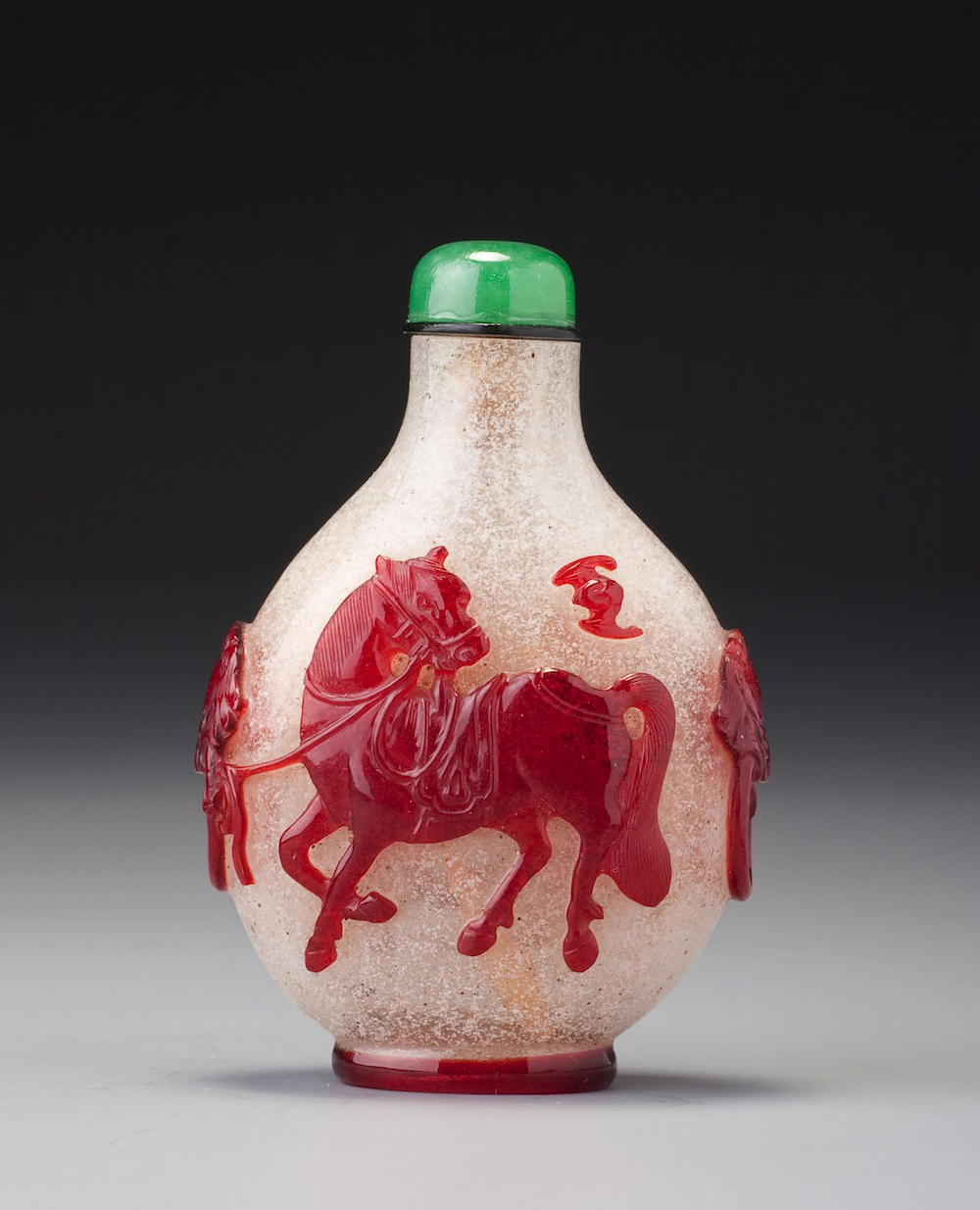
Red overlay glass with horses and bats
China, 1750–1780, Qing dynasty. Snuff bottle. Transparent ruby-red glass with colourless bubble-suffused ground, carved with a horse and a bat on each side, the horses tethered by their halters to mask-and-ring handles on the narrow sides; jadeite stopper. Photo: Bonhams.

Nephrite pebble with scholar on buffalo and farmer
China, 1740–1850, Qing dynasty, Master of the Rocks School. Snuff bottle. Nephrite of pebble material in yellow-green with dark russet-brown skin, carved with a scholar reading on a buffalo above a farmer carrying a plough, with a pavilion, pine tree, lingzhi, and rocky formations; tourmaline stopper. Photo: Bonhams.
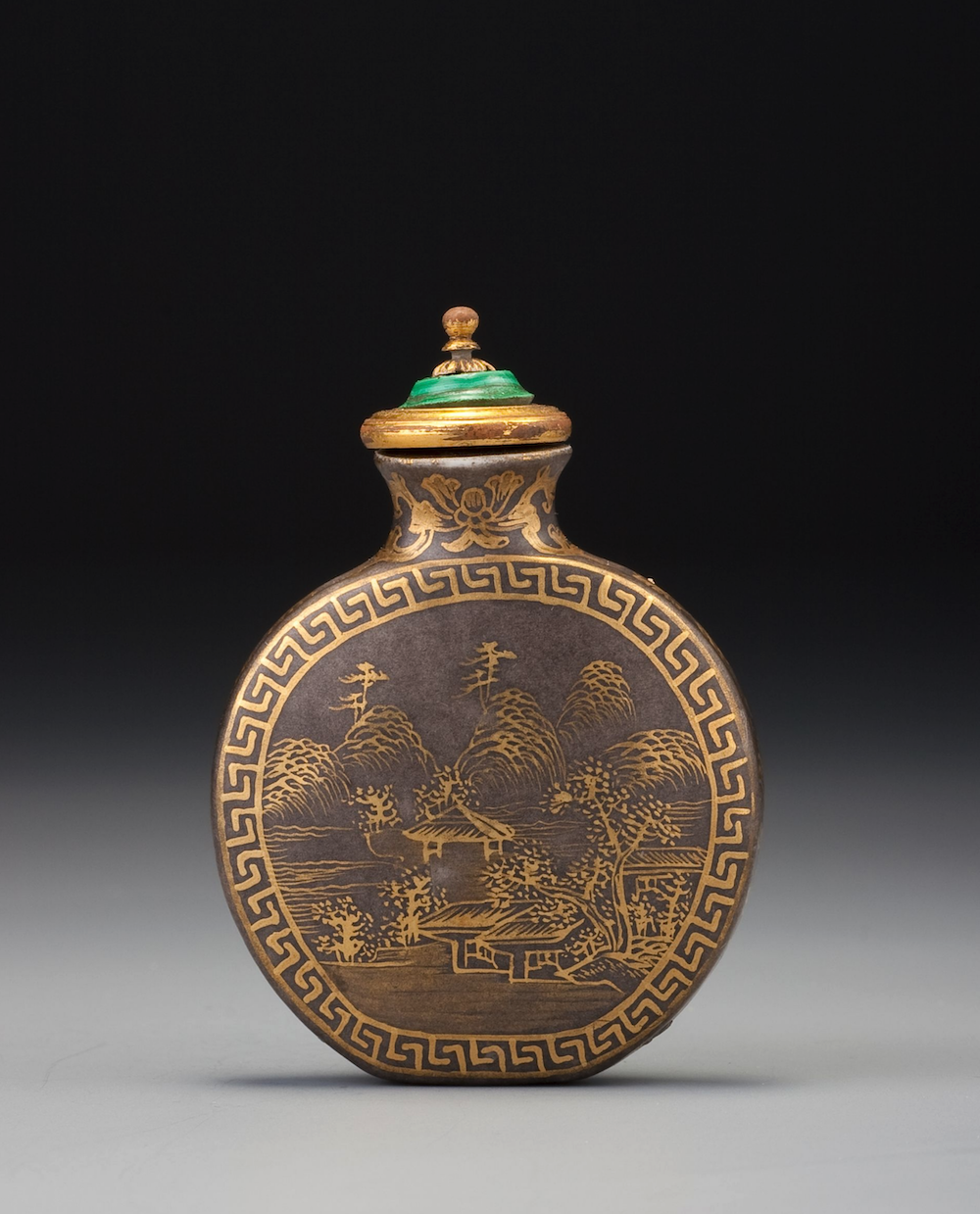
Gold-enamelled porcelain with imperial landscape and poem
China (Jingdezhen, Imperial Kilns), 1760–1799, Qing dynasty, Qianlong period. Snuff bottle. Porcelain painted in gold and metallic-brown enamel with a riverside landscape of a country residence, pavilion, and hills on one side, and an imperial poem preceded by Qianlong yuzhi on the other, both within leiwen borders; Qianlong nianzhi seal mark in gold on base; malachite stopper with gilt-bronze finial and collar. Photo: Bonhams.
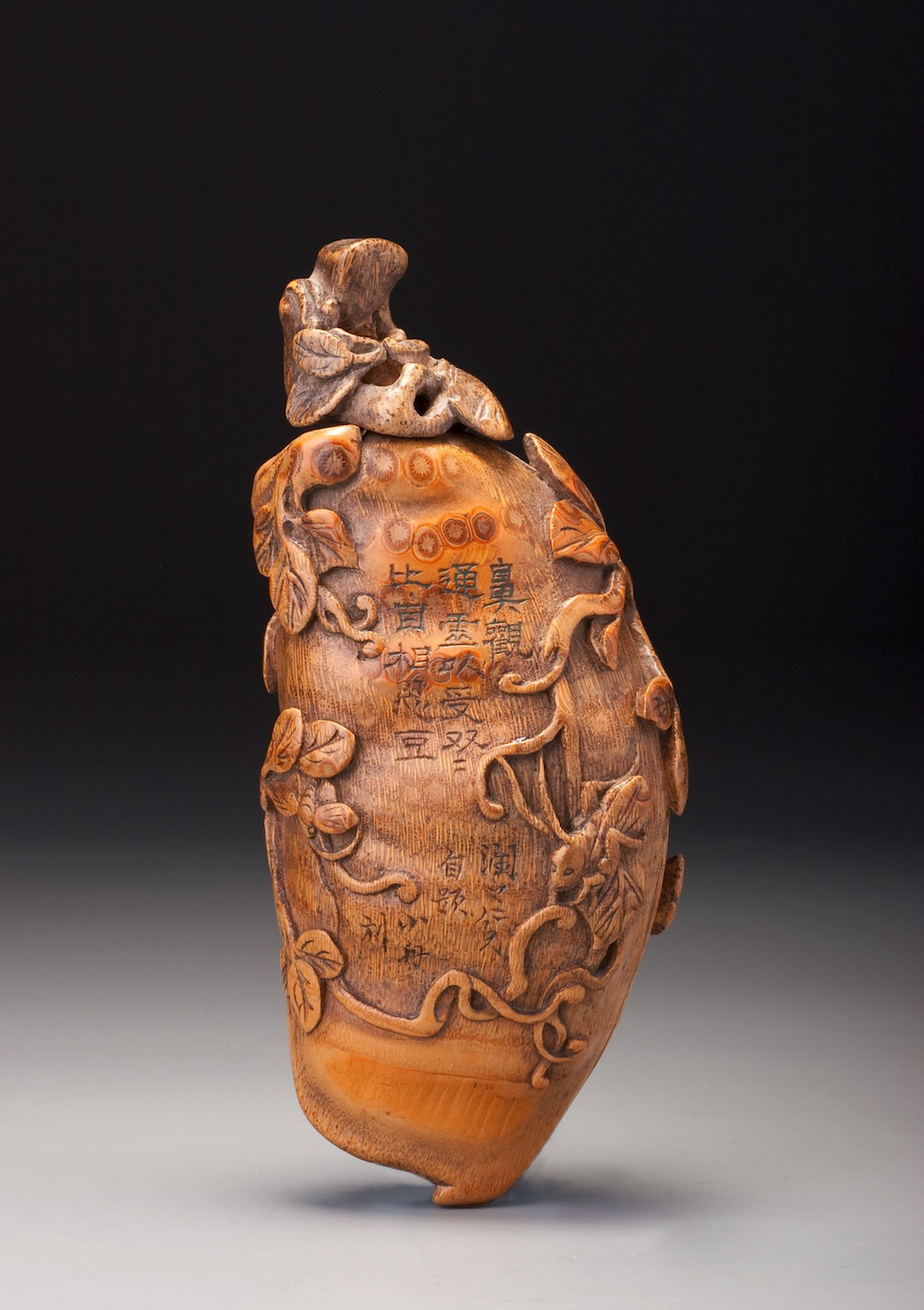
Bamboo double bottle in the form of pea pods with insects and inscription
China, 1730–1850, Qing dynasty. Double snuff bottle. Bamboo root carved in the form of two pea pods with leaves, tendrils, a katydid, and a butterfly; inscribed with a poem composed by Runzhi and engraved by Xiaozhou (possibly Zhang Baopu); original bamboo stoppers and spoons. Photo: Bonhams.
The International Chinese Snuff Bottle Society
2 Hamill Road, Suite 353
Baltimore, MD 21210 USA
410-467-9400