How to Date Chinese Snuff Bottles: Cyclical Calendar Guide
Chinese dates on snuff bottles—especially inside-painted examples from the mid-nineteenth century onward—are written in a system entirely unlike the Western calendar. The year is expressed as a two-character cyclical pair drawn from two interlocking sequences: the ten Heavenly Stems (天干), each linked to one of the Five Elements, and the twelve Earthly Branches (地支), each linked to a zodiac animal. Paired in order, they produce sixty unique combinations—the sexagenary cycle—which repeats every sixty years, so 甲辰 (jiachen) can mean 1904, 1964, or 2024 depending on the object.
The month, when an inscription gives one, is rarely a number. Artists preferred seasonal terms such as 仲秋 (zhongqiu, “mid-autumn,” the 8th month) or poetic names such as 菊月 (juyue, “chrysanthemum month,” the 9th). The reference tables below decode both halves of an inscription date: the first section converts a cyclical year to its Western equivalents, and the second identifies the lunar month by its seasonal or literary name.
The most significant counting system in the Chinese calendar is the Heavenly Stem and Earthly Branch. There are 10 Stems and 12 Branches. Stem and Branch are used together, with the Stem written first (or on top). The Chinese call them Heavenly Stem (天干) and Earthly Branch (地支) and use this specific sequence as the counting system for the calendar.
Each Stem is associated with one of the Five Elements (in yang/yin pairs), and each Branch with one of the twelve zodiac animals. The Stem–Branch pair (干支) is how a cyclical date appears in an inscription: for example, 辛未 (xinwei) corresponds to 1871, 1931, or 1991. The full cycle of 60 combinations repeats every 60 years.
10 Heavenly Stems (天干)
| Order | Character | Pinyin | Element | Icon |
|---|---|---|---|---|
| 1st | 甲 | jia | Wood (yang) | 🌳 |
| 2nd | 乙 | yi | Wood (yin) | 🌳 |
| 3rd | 丙 | bing | Fire (yang) | 🔥 |
| 4th | 丁 | ding | Fire (yin) | 🔥 |
| 5th | 戊 | wu | Earth (yang) | ⛰️ |
| 6th | 己 | ji | Earth (yin) | ⛰️ |
| 7th | 庚 | geng | Metal (yang) | ⚔️ |
| 8th | 辛 | xin | Metal (yin) | ⚔️ |
| 9th | 壬 | ren | Water (yang) | 💧 |
| 10th | 癸 | gui | Water (yin) | 💧 |
12 Earthly Branches (地支)
| Order | Character | Pinyin | Zodiac Animal | Icon |
|---|---|---|---|---|
| 1st | 子 | zi | Rat | 🐀 |
| 2nd | 丑 | chou | Ox | 🐂 |
| 3rd | 寅 | yin | Tiger | 🐅 |
| 4th | 卯 | mao | Rabbit | 🐇 |
| 5th | 辰 | chen | Dragon | 🐉 |
| 6th | 巳 | si | Snake | 🐍 |
| 7th | 午 | wu | Horse | 🐎 |
| 8th | 未 | wei | Goat | 🐐 |
| 9th | 申 | shen | Monkey | 🐒 |
| 10th | 酉 | you | Rooster | 🐓 |
| 11th | 戌 | xu | Dog | 🐕 |
| 12th | 亥 | hai | Pig | 🐖 |
Cyclical Year Table, 1804–2043
The 60 Stem–Branch combinations in cycle order, beginning with 甲子 (jiazi). Read across for every Western year in which that combination occurs.
| # | 1804–1863 | 1864–1923 | 1924–1983 | 1984–2043 | Heavenly Stem | Element | Earthly Branch | Animal | 干支 Pair |
|---|---|---|---|---|---|---|---|---|---|
| 1 | 1804 | 1864 | 1924 | 1984 | 甲 jia (1st) | 🌳 Wood (yang) | 子 zi (1st) | 🐀 Rat | 甲子 jiazi |
| 2 | 1805 | 1865 | 1925 | 1985 | 乙 yi (2nd) | 🌳 Wood (yin) | 丑 chou (2nd) | 🐂 Ox | 乙丑 yichou |
| 3 | 1806 | 1866 | 1926 | 1986 | 丙 bing (3rd) | 🔥 Fire (yang) | 寅 yin (3rd) | 🐅 Tiger | 丙寅 bingyin |
| 4 | 1807 | 1867 | 1927 | 1987 | 丁 ding (4th) | 🔥 Fire (yin) | 卯 mao (4th) | 🐇 Rabbit | 丁卯 dingmao |
| 5 | 1808 | 1868 | 1928 | 1988 | 戊 wu (5th) | ⛰️ Earth (yang) | 辰 chen (5th) | 🐉 Dragon | 戊辰 wuchen |
| 6 | 1809 | 1869 | 1929 | 1989 | 己 ji (6th) | ⛰️ Earth (yin) | 巳 si (6th) | 🐍 Snake | 己巳 jisi |
| 7 | 1810 | 1870 | 1930 | 1990 | 庚 geng (7th) | ⚔️ Metal (yang) | 午 wu (7th) | 🐎 Horse | 庚午 gengwu |
| 8 | 1811 | 1871 | 1931 | 1991 | 辛 xin (8th) | ⚔️ Metal (yin) | 未 wei (8th) | 🐐 Goat | 辛未 xinwei |
| 9 | 1812 | 1872 | 1932 | 1992 | 壬 ren (9th) | 💧 Water (yang) | 申 shen (9th) | 🐒 Monkey | 壬申 renshen |
| 10 | 1813 | 1873 | 1933 | 1993 | 癸 gui (10th) | 💧 Water (yin) | 酉 you (10th) | 🐓 Rooster | 癸酉 guiyou |
| 11 | 1814 | 1874 | 1934 | 1994 | 甲 jia (1st) | 🌳 Wood (yang) | 戌 xu (11th) | 🐕 Dog | 甲戌 jiaxu |
| 12 | 1815 | 1875 | 1935 | 1995 | 乙 yi (2nd) | 🌳 Wood (yin) | 亥 hai (12th) | 🐖 Pig | 乙亥 yihai |
| 13 | 1816 | 1876 | 1936 | 1996 | 丙 bing (3rd) | 🔥 Fire (yang) | 子 zi (1st) | 🐀 Rat | 丙子 bingzi |
| 14 | 1817 | 1877 | 1937 | 1997 | 丁 ding (4th) | 🔥 Fire (yin) | 丑 chou (2nd) | 🐂 Ox | 丁丑 dingchou |
| 15 | 1818 | 1878 | 1938 | 1998 | 戊 wu (5th) | ⛰️ Earth (yang) | 寅 yin (3rd) | 🐅 Tiger | 戊寅 wuyin |
| 16 | 1819 | 1879 | 1939 | 1999 | 己 ji (6th) | ⛰️ Earth (yin) | 卯 mao (4th) | 🐇 Rabbit | 己卯 jimao |
| 17 | 1820 | 1880 | 1940 | 2000 | 庚 geng (7th) | ⚔️ Metal (yang) | 辰 chen (5th) | 🐉 Dragon | 庚辰 gengchen |
| 18 | 1821 | 1881 | 1941 | 2001 | 辛 xin (8th) | ⚔️ Metal (yin) | 巳 si (6th) | 🐍 Snake | 辛巳 xinsi |
| 19 | 1822 | 1882 | 1942 | 2002 | 壬 ren (9th) | 💧 Water (yang) | 午 wu (7th) | 🐎 Horse | 壬午 renwu |
| 20 | 1823 | 1883 | 1943 | 2003 | 癸 gui (10th) | 💧 Water (yin) | 未 wei (8th) | 🐐 Goat | 癸未 guiwei |
| 21 | 1824 | 1884 | 1944 | 2004 | 甲 jia (1st) | 🌳 Wood (yang) | 申 shen (9th) | 🐒 Monkey | 甲申 jiashen |
| 22 | 1825 | 1885 | 1945 | 2005 | 乙 yi (2nd) | 🌳 Wood (yin) | 酉 you (10th) | 🐓 Rooster | 乙酉 yiyou |
| 23 | 1826 | 1886 | 1946 | 2006 | 丙 bing (3rd) | 🔥 Fire (yang) | 戌 xu (11th) | 🐕 Dog | 丙戌 bingxu |
| 24 | 1827 | 1887 | 1947 | 2007 | 丁 ding (4th) | 🔥 Fire (yin) | 亥 hai (12th) | 🐖 Pig | 丁亥 dinghai |
| 25 | 1828 | 1888 | 1948 | 2008 | 戊 wu (5th) | ⛰️ Earth (yang) | 子 zi (1st) | 🐀 Rat | 戊子 wuzi |
| 26 | 1829 | 1889 | 1949 | 2009 | 己 ji (6th) | ⛰️ Earth (yin) | 丑 chou (2nd) | 🐂 Ox | 己丑 jichou |
| 27 | 1830 | 1890 | 1950 | 2010 | 庚 geng (7th) | ⚔️ Metal (yang) | 寅 yin (3rd) | 🐅 Tiger | 庚寅 gengyin |
| 28 | 1831 | 1891 | 1951 | 2011 | 辛 xin (8th) | ⚔️ Metal (yin) | 卯 mao (4th) | 🐇 Rabbit | 辛卯 xinmao |
| 29 | 1832 | 1892 | 1952 | 2012 | 壬 ren (9th) | 💧 Water (yang) | 辰 chen (5th) | 🐉 Dragon | 壬辰 renchen |
| 30 | 1833 | 1893 | 1953 | 2013 | 癸 gui (10th) | 💧 Water (yin) | 巳 si (6th) | 🐍 Snake | 癸巳 guisi |
| 31 | 1834 | 1894 | 1954 | 2014 | 甲 jia (1st) | 🌳 Wood (yang) | 午 wu (7th) | 🐎 Horse | 甲午 jiawu |
| 32 | 1835 | 1895 | 1955 | 2015 | 乙 yi (2nd) | 🌳 Wood (yin) | 未 wei (8th) | 🐐 Goat | 乙未 yiwei |
| 33 | 1836 | 1896 | 1956 | 2016 | 丙 bing (3rd) | 🔥 Fire (yang) | 申 shen (9th) | 🐒 Monkey | 丙申 bingshen |
| 34 | 1837 | 1897 | 1957 | 2017 | 丁 ding (4th) | 🔥 Fire (yin) | 酉 you (10th) | 🐓 Rooster | 丁酉 dingyou |
| 35 | 1838 | 1898 | 1958 | 2018 | 戊 wu (5th) | ⛰️ Earth (yang) | 戌 xu (11th) | 🐕 Dog | 戊戌 wuxu |
| 36 | 1839 | 1899 | 1959 | 2019 | 己 ji (6th) | ⛰️ Earth (yin) | 亥 hai (12th) | 🐖 Pig | 己亥 jihai |
| 37 | 1840 | 1900 | 1960 | 2020 | 庚 geng (7th) | ⚔️ Metal (yang) | 子 zi (1st) | 🐀 Rat | 庚子 gengzi |
| 38 | 1841 | 1901 | 1961 | 2021 | 辛 xin (8th) | ⚔️ Metal (yin) | 丑 chou (2nd) | 🐂 Ox | 辛丑 xinchou |
| 39 | 1842 | 1902 | 1962 | 2022 | 壬 ren (9th) | 💧 Water (yang) | 寅 yin (3rd) | 🐅 Tiger | 壬寅 renyin |
| 40 | 1843 | 1903 | 1963 | 2023 | 癸 gui (10th) | 💧 Water (yin) | 卯 mao (4th) | 🐇 Rabbit | 癸卯 guimao |
| 41 | 1844 | 1904 | 1964 | 2024 | 甲 jia (1st) | 🌳 Wood (yang) | 辰 chen (5th) | 🐉 Dragon | 甲辰 jiachen |
| 42 | 1845 | 1905 | 1965 | 2025 | 乙 yi (2nd) | 🌳 Wood (yin) | 巳 si (6th) | 🐍 Snake | 乙巳 yisi |
| 43 | 1846 | 1906 | 1966 | 2026 | 丙 bing (3rd) | 🔥 Fire (yang) | 午 wu (7th) | 🐎 Horse | 丙午 bingwu |
| 44 | 1847 | 1907 | 1967 | 2027 | 丁 ding (4th) | 🔥 Fire (yin) | 未 wei (8th) | 🐐 Goat | 丁未 dingwei |
| 45 | 1848 | 1908 | 1968 | 2028 | 戊 wu (5th) | ⛰️ Earth (yang) | 申 shen (9th) | 🐒 Monkey | 戊申 wushen |
| 46 | 1849 | 1909 | 1969 | 2029 | 己 ji (6th) | ⛰️ Earth (yin) | 酉 you (10th) | 🐓 Rooster | 己酉 jiyou |
| 47 | 1850 | 1910 | 1970 | 2030 | 庚 geng (7th) | ⚔️ Metal (yang) | 戌 xu (11th) | 🐕 Dog | 庚戌 gengxu |
| 48 | 1851 | 1911 | 1971 | 2031 | 辛 xin (8th) | ⚔️ Metal (yin) | 亥 hai (12th) | 🐖 Pig | 辛亥 xinhai |
| 49 | 1852 | 1912 | 1972 | 2032 | 壬 ren (9th) | 💧 Water (yang) | 子 zi (1st) | 🐀 Rat | 壬子 renzi |
| 50 | 1853 | 1913 | 1973 | 2033 | 癸 gui (10th) | 💧 Water (yin) | 丑 chou (2nd) | 🐂 Ox | 癸丑 guichou |
| 51 | 1854 | 1914 | 1974 | 2034 | 甲 jia (1st) | 🌳 Wood (yang) | 寅 yin (3rd) | 🐅 Tiger | 甲寅 jiayin |
| 52 | 1855 | 1915 | 1975 | 2035 | 乙 yi (2nd) | 🌳 Wood (yin) | 卯 mao (4th) | 🐇 Rabbit | 乙卯 yimao |
| 53 | 1856 | 1916 | 1976 | 2036 | 丙 bing (3rd) | 🔥 Fire (yang) | 辰 chen (5th) | 🐉 Dragon | 丙辰 bingchen |
| 54 | 1857 | 1917 | 1977 | 2037 | 丁 ding (4th) | 🔥 Fire (yin) | 巳 si (6th) | 🐍 Snake | 丁巳 dingsi |
| 55 | 1858 | 1918 | 1978 | 2038 | 戊 wu (5th) | ⛰️ Earth (yang) | 午 wu (7th) | 🐎 Horse | 戊午 wuwu |
| 56 | 1859 | 1919 | 1979 | 2039 | 己 ji (6th) | ⛰️ Earth (yin) | 未 wei (8th) | 🐐 Goat | 己未 jiwei |
| 57 | 1860 | 1920 | 1980 | 2040 | 庚 geng (7th) | ⚔️ Metal (yang) | 申 shen (9th) | 🐒 Monkey | 庚申 gengshen |
| 58 | 1861 | 1921 | 1981 | 2041 | 辛 xin (8th) | ⚔️ Metal (yin) | 酉 you (10th) | 🐓 Rooster | 辛酉 xinyou |
| 59 | 1862 | 1922 | 1982 | 2042 | 壬 ren (9th) | 💧 Water (yang) | 戌 xu (11th) | 🐕 Dog | 壬戌 renxu |
| 60 | 1863 | 1923 | 1983 | 2043 | 癸 gui (10th) | 💧 Water (yin) | 亥 hai (12th) | 🐖 Pig | 癸亥 guihai |
A dated inscription on an inside-painted snuff bottle rarely gives the month as a number. After the cyclical year, the artist typically names the month with a seasonal or poetic term: 乙未仲秋 reads “mid-autumn (8th month) of the yiwei year (1895),” and 辛丑桂月 “osmanthus month (8th month) of 1901.” The seasonal system divides each season into 孟 meng (first), 仲 zhong (middle), and 季 ji (last) months, while the poetic names usually refer to the flower or custom of the season. Use this table together with the Cyclical Year Table above to convert a full inscription date to a Western year and month description.
| Month | Seasonal Name | Poetic & Literary Names |
|---|---|---|
| 一月 1st month | 孟春 mengchun first spring | 正月 zhengyue (principal month) · 陬月 zouyue (corner month) · 端月 duanyue (beginning month) · 元月 yuanyue (primary month) |
| 二月 2nd month | 仲春 zhongchun mid-spring | 杏月 xingyue (apricot month) · 如月 ruyue (month of following) · 花月 huayue (flower month) |
| 三月 3rd month | 季春 jichun late spring | 桃月 taoyue (peach month) · 蚕月 canyue (silkworm month) · 暮春 muchun (waning spring) |
| 四月 4th month | 孟夏 mengxia first summer | 梅月 meiyue (plum month) · 麦月 maiyue (wheat month) · 余月 yuyue (month of abundance) · 清和月 qingheyue (clear and mild month) |
| 五月 5th month | 仲夏 zhongxia mid-summer | 榴月 liuyue (pomegranate month) · 蒲月 puyue (calamus month) · 皋月 gaoyue (marsh month) |
| 六月 6th month | 季夏 jixia late summer | 荷月 heyue (lotus month) · 伏月 fuyue (dog days month) · 且月 juyue (classical almanac name) |
| 七月 7th month | 孟秋 mengqiu first autumn | 巧月 qiaoyue (Qixi festival month) · 瓜月 guayue (melon month) · 兰月 lanyue (orchid month) · 相月 xiangyue (classical almanac name) |
| 八月 8th month | 仲秋 zhongqiu mid-autumn | 桂月 guiyue (osmanthus month) · 壮月 zhuangyue (robust month) |
| 九月 9th month | 季秋 jiqiu late autumn | 菊月 juyue (chrysanthemum month) · 玄月 xuanyue (dark month) |
| 十月 10th month | 孟冬 mengdong first winter | 阳月 yangyue (yang month) · 小阳春 xiaoyangchun (little spring) · 亥月 haiyue (hai-branch month) |
| 十一月 11th month | 仲冬 zhongdong mid-winter | 葭月 jiayue (reed month) · 霜月 shuangyue (frost month) · 辜月 guyue (classical almanac name) |
| 十二月 12th month | 季冬 jidong late winter | 腊月 layue (month of sacrificial rites) · 涂月 tuyue (classical almanac name) · 嘉平月 jiapingyue (auspicious peace month) |
Relating Lunar Months to the Western Calendar
The lunar months have no fixed Western equivalents. Each month begins on a new moon, and the year is kept aligned with the seasons by inserting an intercalary month (闰月, runyue) about every three years, so the whole calendar drifts within a roughly one-month band. As a rule of thumb, lunar month n falls mostly within Western month n + 1: the 1st month spans roughly February, the 8th month (仲秋) falls mostly in September, and the 12th month (腊月) in January.
Two cautions when dating an inscription. First, a bottle dated to the 12th month was very likely painted in January or early February of the following Western year: 辛丑腊月 is better read as January–February 1902 than as December 1901, even though 辛丑 corresponds to 1901 in the Cyclical Year Table above. Second, inscriptions occasionally prefix a month with 闰 (run), as in 闰五月, “intercalary 5th month”—a repeated month inserted in that particular year to keep the calendar aligned with the sun.
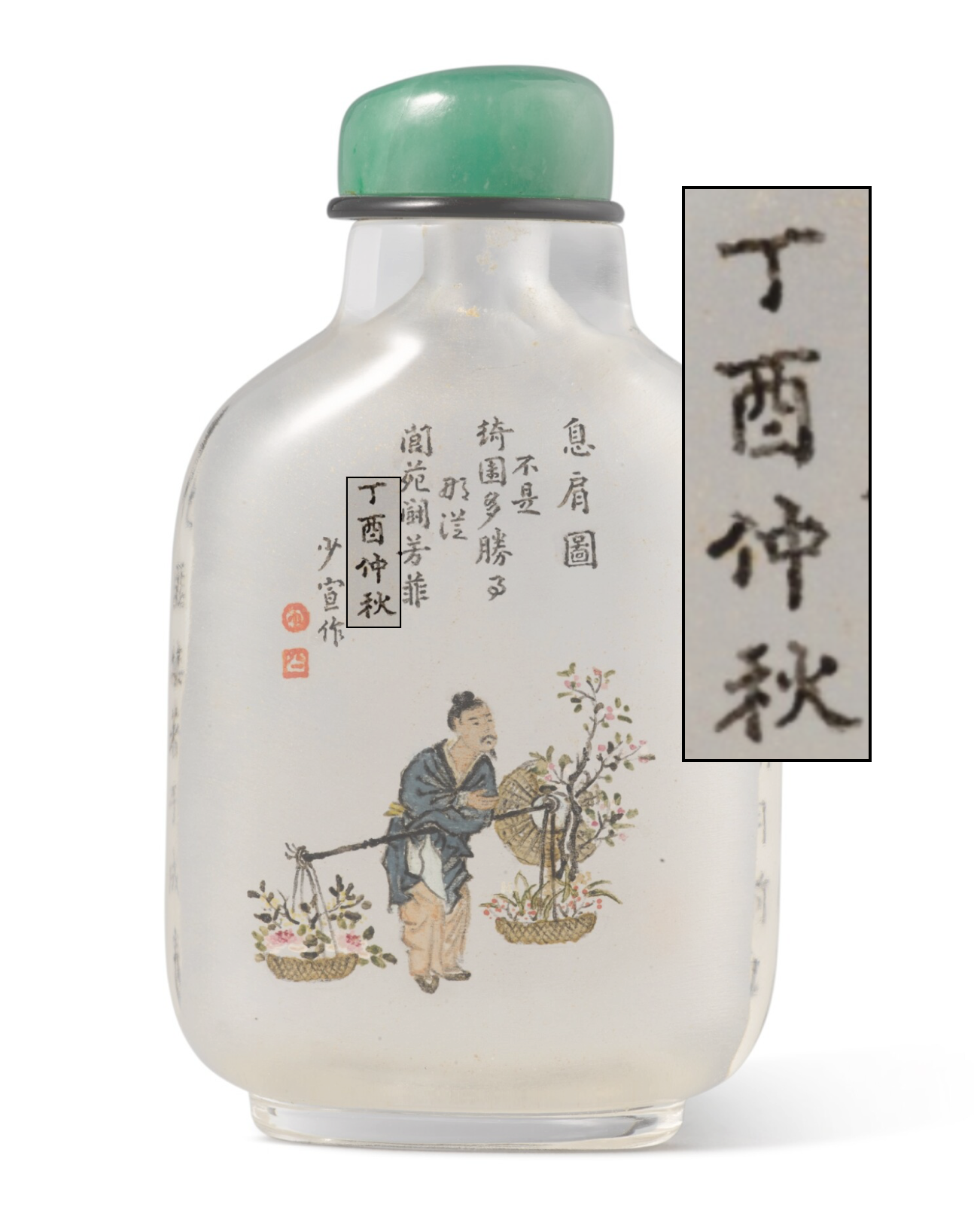
Photo: Sotheby's
This inside-painted glass bottle by 馬少宣 Ma Shaoxuan (1867–1939) shows how the two reference tables above work together on a real object. The painting depicts a flower vendor pausing with his carrying pole and baskets of blossoms; the artist titled it 息肩圖, “Picture of Resting the Shoulders.” The columns of small script beside the title contain a poetic couplet, the date, and the signature—and the date is the part that concerns us here, enlarged in the detail at right of the photograph: 丁酉仲秋.
Step 1: Find the production inscription
On Ma Shaoxuan’s bottles the dated production inscription almost always sits on the pictorial face, immediately before the signature. Here the final two columns read 丁酉仲秋少宣作 — “made by Shaoxuan in the mid-autumn month of the dingyou year.” The formula is standard: cyclical year, then month, then name, then 作 (“made by”). The other face of this bottle carries only calligraphy and the signature, with no date at all — a reminder to always check both faces.
Step 2: Read the cyclical year
丁酉 (dingyou) combines the 4th Heavenly Stem 丁 ding (Fire, yin) with the 10th Earthly Branch 酉 you (the Rooster). In the Cyclical Year Table above this is combination #34, corresponding to 1837, 1897, 1957, or 2017. The cyclical date alone never tells you which — that ambiguity is built into the system, since the cycle repeats every sixty years.
Step 3: Choose the right sixty-year cycle
The ambiguity is resolved by what is known about the object and the artist. Ma Shaoxuan’s working career ran from roughly the early 1890s into the 1920s, which eliminates 1837 and 1957 immediately. 丁酉 therefore means 1897 — early in his career, consistent with the refinement of the painting. This step is where connoisseurship enters: the tables convert the characters, but the artist’s biography, the style, and the object itself select the cycle.
Step 4: Read the month
仲秋 zhongqiu is a seasonal month name from the Lunar Months table above: 仲 zhong marks the middle month of a season, and 秋 qiu is autumn, so 仲秋 is the 8th lunar month. Applying the rough one-month offset described in the note on Western equivalents, the 8th lunar month of 1897 falls mostly in September 1897.
Step 5: The full reading
丁酉仲秋少宣作: “Made by Shaoxuan in the mid-autumn month of the dingyou year" (approximately September 1897).
A caution about literary dates
Literary texts quoted on bottles are the source of the most common dating mistake. Consider a bottle whose quoted poem contains the phrase 此秋, “this autumn.” A careless reader might interpret that as the date of painting rather than as part of the quoted text. Seasonal words inside a quoted text are literary content; only the production inscription—the cyclical year and month attached to the signature—dates the object. Bottles with no production inscription at all are common, and their dating rests on style, subject, seals, and comparison rather than on any written date.
The International Chinese Snuff Bottle Society
2 Hamill Road, Suite 353
Baltimore, MD 21210 USA
410-467-9400